


8 Best Cheer Skills for Beginners to Build First
A sharp high V, a confident voice, and a safe forward roll may not look like the biggest skills on the floor, but they are where strong cheerleaders begin. The best cheer skills for beginners are not always the flashiest ones. They are the skills that teach young athletes how to move with control, listen to coaching, trust their teammates, and enjoy the process of improving.
For parents, that foundation matters just as much as a new jump or tumbling pass. Cheerleading asks athletes to combine strength, coordination, performance, teamwork, and focus. Starting with the right skills helps beginners feel successful early while preparing them for the next level at a pace that protects both their confidence and their safety.
Why beginner cheer skills should come first
It can be tempting to focus on back handsprings, high baskets, or advanced stunts when a child first becomes interested in cheer. Those skills are exciting, but they depend on smaller habits that must come first: body awareness, proper landing positions, strong arm placement, and the ability to follow directions as part of a group.
A thoughtful beginner program builds those habits one layer at a time. Athletes learn that clean technique matters, not because cheer has to be perfect, but because technique helps them train safely and progress with confidence. The athlete who learns to lock out her arms in a motion, keep her chest up in a squat, and land quietly from a jump is developing skills that carry into tumbling, stunting, and team routines.
Progress also looks different for every child. Some beginners are naturally flexible. Others have strong rhythm, fearless energy, or an easy ability to connect with teammates. Great coaching meets athletes where they are and gives them clear next steps.
8 best cheer skills for beginners
1. Strong cheer motions
Cheer motions are the arm positions that make chants, dances, and routines look clean and powerful. Beginners should learn foundational positions such as high V, low V, touchdown, T, broken T, clasp, daggers, and clean. The goal is not simply knowing the names. Athletes need to hit each motion with straight arms, tight fists, lifted posture, and purposeful energy.
Clean motions teach body control and attention to detail. They also help beginners gain confidence quickly because they can see and feel the improvement from one practice to the next.
2. Counts, rhythm, and performance timing
Cheerleading is a team sport, which means timing matters. A beginner who can count eight-count sequences and move with the group has a major advantage when learning chants, dances, transitions, and routines. Counting out loud at first can feel silly, but it gives athletes a dependable framework.
Rhythm is not only about dance ability. It is also about listening, reacting, and learning to start and finish together. Encourage beginners to practice short motion combinations to counts of eight, then add a smile, eye contact, and strong performance energy.
3. Proper jump shapes and landing mechanics
Jumps are a favorite part of cheer, but height should never come before shape and safety. Beginners benefit from learning a controlled dip, arm swing, tight core, pointed toes, and soft landing before working toward more advanced jumps.
Start with straight jumps, tuck jumps, and jump drills that teach athletes to land with bent knees, feet together when appropriate, and their weight balanced. A clean landing protects the ankles and knees while building the strength needed for toe touches, herkie jumps, and other cheer staples later on.
4. Basic flexibility and body positions
Flexibility supports many areas of cheer, including jumps, motions, stunts, and tumbling. Beginners do not need oversplits or picture-perfect heel stretches on day one. They do need consistent, age-appropriate work on hamstrings, hips, shoulders, ankles, and back mobility.
The key is patience. Stretching should be supervised, gradual, and never forced. Athletes who practice good body positions - such as a tight hollow hold, a strong lunge, and a pointed toe - often progress more smoothly than athletes who chase flexibility without control.
5. Tumbling fundamentals
Safe tumbling begins long before a back handspring. Forward rolls, backward rolls, cartwheels, handstands, bridges, and roundoff preparation help athletes develop spatial awareness, shoulder strength, core control, and confidence upside down.
Not every beginner will progress through these skills at the same speed, and that is completely normal. Some children need extra time to feel comfortable putting weight through their hands or moving backward. Trained coaches can use drills, mats, spotting, and progressions that help athletes build trust in their bodies without skipping essential steps.
6. Stunt readiness and safe spotting habits
Beginning cheerleaders may be eager to fly, base, or try partner stunts right away. Before a team works on more complex skills, athletes should understand athletic stance, tight body positions, safe grips, communication, and how to listen closely to a coach.
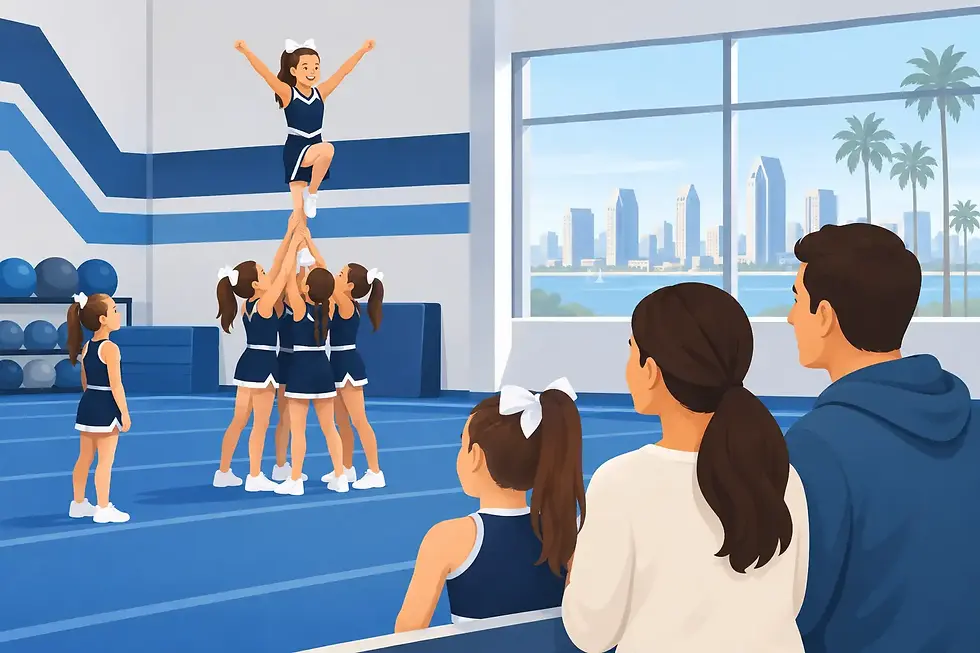
Stunting is never a solo skill. A strong beginner learns that every role matters. Bases need stable legs and focused eyes. Flyers need tight cores and body awareness. Back spots need to stay engaged and ready. The best early stunting experiences are carefully supervised and designed to teach trust, not rush difficulty.
7. Voice, facials, and crowd connection
Cheer is athletic, but it is also performance. A beginner who learns to project a chant, use facial expressions, and perform with energy gains a valuable part of the sport that cannot be measured by a tumbling level alone.
This can be especially meaningful for shy athletes. At first, projecting may mean saying the words with the group. Over time, it can become a confident voice, lifted chin, and genuine smile in front of a crowd. Coaches should create a supportive environment where athletes can practice being seen without fear of making a mistake.
8. Teamwork, accountability, and coachability
The most valuable beginner skills are not all physical. Cheerleaders need to be dependable teammates: arriving prepared, listening when someone else is speaking, encouraging teammates, and trying again after a correction. These habits make practices more productive and help every athlete feel that they belong.
Coachability is especially powerful. When an athlete can hear feedback without shutting down, apply a correction, and celebrate small wins, progress accelerates. Those lessons reach far beyond the mat, building perseverance, responsibility, and leadership.
What progress should look like for a new cheerleader
Beginner progress is rarely a straight line. An athlete may learn a cartwheel quickly but need more time with motions. Another may shine in performance but feel nervous during stunts. Rather than comparing children, look for meaningful signs of growth: better focus during class, stronger posture, safer landings, willingness to try, and more confidence with teammates.
A quality program should make those milestones clear. Families deserve to understand what their athlete is practicing, why the skill matters, and what comes next. Regular communication also helps parents support their child without turning practice at home into pressure.
Choosing the right place to learn beginner cheer
For a first cheer experience, the environment matters as much as the curriculum. Look for coaches who prioritize proper progressions, use age-appropriate instruction, and make safety part of every class. A smaller athlete should not be expected to train exactly like an older athlete, and a new cheerleader should not be rushed into skills before the foundation is there.
The right gym also creates a culture where athletes feel known. At Cali Coast Elite, beginner programs are designed to give young athletes a welcoming place to learn cheer fundamentals while building confidence, discipline, and genuine team connection. Whether a child hopes to join a competitive team one day or simply wants an active, encouraging class, a clear progression makes the experience more rewarding.
The first clean motion, safe cartwheel, or confident chant may seem like a small moment. For a beginner, it can be the moment they realize they are capable of more than they thought - and that is a powerful place for their cheer journey to begin.


Comments