


Cheerleading Versus Gymnastics for Your Child
A back handspring can happen in both sports. So can strong core muscles, courage, focus, and the pride that comes from learning something that once felt impossible. But when families compare cheerleading versus gymnastics, they are choosing between two athletic paths with different goals, environments, and opportunities for connection.
For some children, gymnastics is the perfect place to pursue individual technical precision. For others, cheerleading brings out their best through team routines, stunts, tumbling, performance, and shared accountability. Neither is automatically better. The best fit is the one that helps your athlete feel challenged, safe, supported, and excited to return to practice.
Cheerleading Versus Gymnastics: The Core Difference
Gymnastics centers on individual events. Athletes typically train and compete in skills performed on apparatus such as floor, beam, bars, vault, rings, pommel horse, or parallel bars, depending on the program. Progress depends heavily on an athlete's individual technique, strength, flexibility, consistency, and ability to perform under pressure.
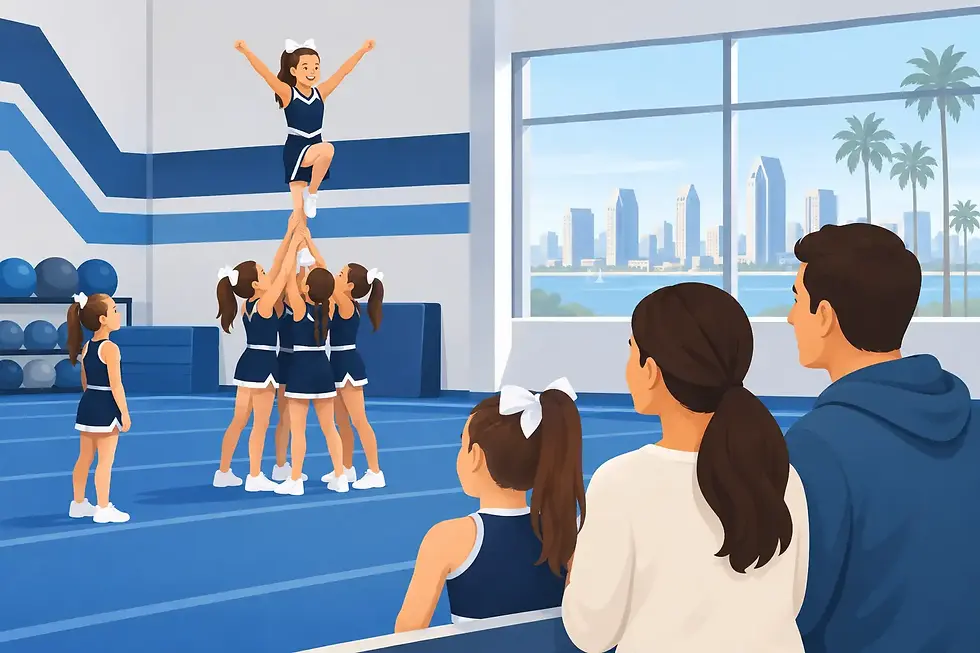
All-star cheerleading is a team sport built around a routine. Athletes contribute through tumbling, stunting, jumps, dance, motions, formations, and performance. A cheer routine succeeds when every athlete does their job at the right moment. One athlete may be a powerful base, another may be a confident flyer, and another may bring advanced tumbling that raises the team's difficulty level.
That difference matters for children who thrive in different ways. A child who loves refining a personal skill sequence may enjoy gymnastics. A child who lights up when working toward a common goal with teammates may feel at home in cheer.
Skills That Transfer Between Both Sports
Cheerleading and gymnastics share a valuable athletic foundation. Both help athletes build body awareness, coordination, flexibility, strength, balance, discipline, and resilience. Tumbling is the most visible overlap. Skills such as cartwheels, round-offs, back handsprings, aerials, and full twists can be valuable in both environments.
Still, the purpose of the skill can be different. In gymnastics, a tumbling pass is judged as part of an individual floor routine, with close attention to form, amplitude, landings, and connections. In cheerleading, tumbling adds difficulty and excitement to a larger team routine. An athlete must also learn to tumble in formations, match timing, and transition quickly into stunts, jumps, or choreography.
Cheer athletes also develop skills that gymnastics does not always emphasize in the same way. Stunting requires trust, communication, spatial awareness, and consistent technique from every member of the group. Athletes learn that a strong routine is not only about what they can do alone. It is about how well they can show up for the people beside them.
The Team Experience Can Be a Big Deciding Factor
Many parents choose cheerleading because their child wants an athletic activity with a strong sense of belonging. All-star cheer teams practice together for months, celebrate new skills together, work through tough practices together, and compete together. That can be especially meaningful for athletes who want both a sport and a close-knit community.
Team life also teaches practical life skills. Athletes learn to listen, take corrections, communicate respectfully, arrive prepared, and stay accountable when others depend on them. They learn how to celebrate a teammate's first back handspring even if they mastered theirs months ago. They also learn how to regroup after a difficult performance instead of placing blame.
Gymnastics can absolutely provide friendships and supportive coaching, especially in a positive gym culture. Yet competition is usually more individual. The athlete's score, routine, and progression are primarily their own. Some children find that independence motivating. Others prefer the shared energy and responsibility of a cheer team.
Safety Depends on Coaching, Progression, and Environment
Parents should expect safety to be a priority in either sport. Tumbling, stunting, and gymnastics apparatus all require appropriate instruction, proper surfaces, active supervision, and skill progressions that respect an athlete's readiness.
A quality program does not rush a child into a back handspring, high-level stunt, or advanced apparatus skill because they are eager to move up. Coaches should build the prerequisites first: body positions, strength, flexibility, landing mechanics, confidence, and consistent execution. Safe progression may not always feel fast, but it creates a stronger athlete over time.
In cheerleading, safety also relies on the team. Stunting groups must understand grips, loading positions, spotting, dismounts, and clear communication. Athletes should be placed in roles that suit their current skill level, size, strength, and maturity. At Cali Coast Elite, USASF-trained and certified coaches focus on age-appropriate placement and technique so athletes can grow with confidence.
When visiting any gym, parents can ask how coaches evaluate readiness, how classes are grouped, what safety training staff complete, and how the program handles injuries or concerns. Clear, straightforward answers are a good sign.
Time Commitment and Competition Expectations
The schedule is another meaningful difference in cheerleading versus gymnastics. Recreational gymnastics can offer one or two classes each week, while competitive gymnastics often requires a significant training commitment as levels advance. The pathway can be highly structured, with athletes working toward specific levels and competition standards.
Cheerleading can also range widely. Introductory cheer classes and tumbling programs are a low-pressure way to build fundamentals. Half-year teams may offer a shorter commitment for families exploring competitive cheer. Full-season all-star teams generally require regular practices, choreography, competitions, and a commitment to the group.
Neither path has to begin at the highest level. In fact, beginners often benefit most from a program that lets them learn the culture, build foundational skills, and decide what level of participation fits their family. A child does not need to arrive with an advanced tumbling pass to begin cheerleading. They need a willingness to learn, practice, and support their teammates.
What About Cost?
Costs vary by gym, season, location, and competitive level. Families should look beyond the monthly tuition and ask for a full picture of possible expenses. Competitive programs may include registration, uniforms, practice wear, choreography, competition fees, travel, and optional private lessons. Gymnastics programs may have their own fees for meets, apparel, memberships, and equipment-related expenses.
The right question is not simply which sport costs less. It is whether the experience, coaching quality, schedule, and athlete development feel worthwhile for your family. A transparent program should explain expected costs early, offer clear options when possible, and help parents understand what each level of participation involves.
How to Tell Which Sport Fits Your Child
Listen to what your child talks about after practice or after watching a competition. Do they point out flips and ask how to improve their own form? Do they notice the music, formations, uniforms, and crowd energy? Are they more motivated by beating a personal goal or contributing to a group performance?
It can also help to consider your child's temperament. A detail-oriented athlete who enjoys working independently may be drawn to gymnastics. A social athlete who enjoys performing, encouraging others, and building relationships may love cheerleading. But these are not fixed rules. Quiet children can become confident cheerleaders, and highly social children can thrive in gymnastics.
Before committing, use a trial class, introductory program, camp, or open gym session to see how your child responds. Pay attention to more than whether they can perform a skill right away. Notice whether the coaching style makes them feel safe, whether they are engaged, and whether they leave feeling proud of their effort.
A Sport Should Build More Than Skills
Both cheerleading and gymnastics can shape capable, disciplined athletes. The choice comes down to what kind of challenge and community will help your child grow. If they are energized by tumbling, performance, teamwork, and the chance to work toward a shared routine, cheerleading may be the place where they find their voice.
Give your athlete room to try, learn, and take the next step at their own pace. The right program will meet them where they are, challenge them with care, and make them feel that they belong long before competition day.


Comments